CP26/20 & Post-Options SIPP Due Diligence: Why "Execution-Only" Disclaimers Will No Longer Save Operators or Introducers

Whilst dealing with SIPP due diligence investigations at the FOS a common pattern was weak attempts to get out of responsibility and accountability in regards to whether regulated financial advice was provided or not.
Self-Invested Personal Pension (SIPP) due diligence has been litigated in the shadow of landmark court battles: Berkeley Burke, Avacade, and the two Court of Appeal rulings in Options UK Personal Pensions LLP (formerly Carey Pensions). Throughout that period, operators and introducers leaned heavily on non-Handbook guidance (FG 13/8), execution-only client disclaimers, and contractual undertakings that introducers were ‘not giving regulated advice’.
With FCA Consultation Paper CP26/20 (Adapting our rules for a changing market: self-invested personal pensions), which closed in August 2026 ahead of the Policy Statement and phased implementation, that era of interpretative ambiguity is well and truly over. The FCA is replacing FG 13/8 with binding, enforceable Handbook rules alongside a new Pension Scheme Money and Assets (PSM&A) regime.
When you read CP26/20 alongside recent Financial Ombudsman Service (FOS) decisions applying the Options UK Court of Appeal framework a clear regulatory reality emerges: execution-only terms of business do not insulate a SIPP operator from PRIN 2, COBS 2.1.1R, PRIN 2A (Consumer Duty), or FSMA Section 27 unenforceability.
1. The Post-Options FOS Benchmark: What Actually Defends an Operator?
A persistent piece of industry disinformation, often amplified by some Claims Management Companies (CMCs), is that SIPP operators are now strict-liability insurers for any investment loss inside a non-advised SIPP.
Recent FOS decisions prove that is false, while simultaneously drawing a razor-sharp line between defensible governance and guaranteed upholds:
Where Operators Lose (DRN-4615639 & DRN-3151523 - Options UK): Where an operator accepts transfers or investments via an unregulated introducer despite internal compliance flagging amber/high-risk indicators, or onboards opaque overseas fractional property/loan notes without verifying legally enforceable title, custody, and independent ongoing valuation, signed execution-only disclaimers are irrelevant.
A startling observation of the first decision is that it was an unfunded pensions (armed forces) pension in the first place and was effectively transferred using the unregulated introducer (and a rubber stamp at the MOD) and then ultimately (once the FOS made its decisions) complainants were quite rightly put back into the position they should have been in…and paid by….
The second decision background appears to show the promise of an exotic holiday with high returns to boot.
Under PRIN 2A.10.2R and the FCA’s SIPP Operators Portfolio Letter, firms receiving a lead FOS decision must proactively apply that reasoning across non-complaining cohorts rather than forcing customers to litigate.
And based on the update provided in the letter (with it now being over 2 years later) obligations of being a distributor must be embedded as well as a more granular take on specific target market.
SIPP Operators & Non-Standard Assets
Where Operators Win (DRN-5805611 - DP Pensions & DRN-5168757 - AJ Bell): In DP Pensions (2025), applying the 2024 Court of Appeal standard, FOS rejected a due diligence complaint because the operator held contemporaneous, documented checks proving the introducing adviser held valid FCA permissions, Persons with Significant Control (PSCs) had clean regulatory histories, and the underlying asset showed no red flags of fraud, impairment, or inability to value independently at onboarding. Similarly, in AJ Bell (2024), FOS confirmed that COBS 2.1.1R does not require execution-only operators to block standard, readily realisable LSE/AIM-listed equities.
The Takeaway for Boards: Defensibility does not come from client disclaimers; it comes from contemporaneous, documented onboarding files proving the introducer and asset passed objective risk gates before a penny moved.
2. Four Structural Shifts Under FCA CP26/20
CP26/20 codifies the lessons of Options UK and Gaudi Regulated Services (DRN-4045393) directly into the FCA Handbook across four pillars:
Binding Handbook Shift
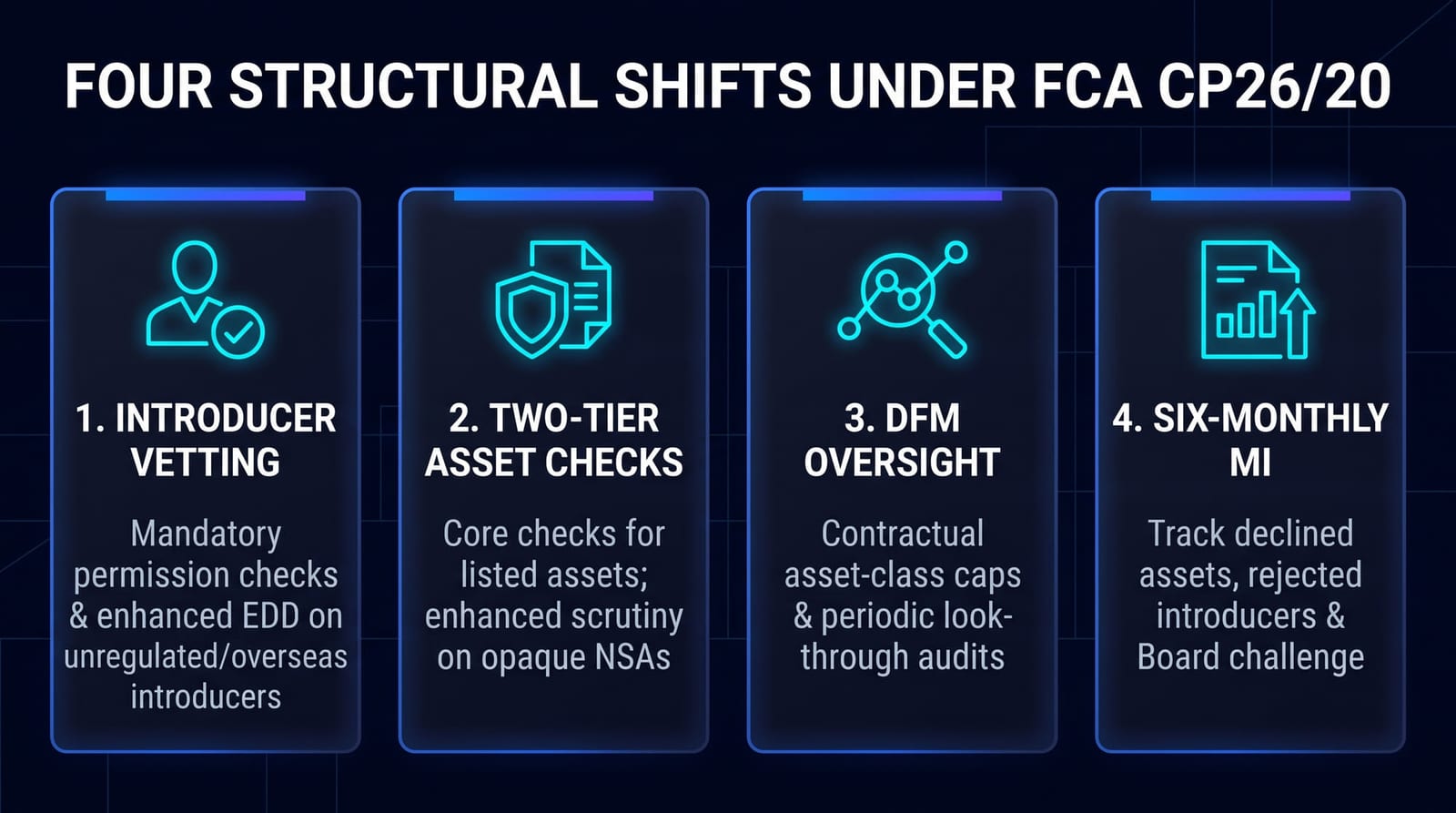
What Boards, Introducers & Manufacturers Must Do:
1. Third-Party & Introducer Vetting
Mandatory core permission checks for all introducers, plus enhanced due diligence on unregulated and overseas introducers before accepting business.
Investigate corporate structures, PSC disciplinary histories, and high-risk lead-generation funnels. If undue risk cannot be ruled out, operators must decline or terminate the relationship.
2. Two-Tier Asset Due Diligence
Core checks (good title, proper custody, admin capability) suffice for cash and readily realisable listed securities; opaque or non-standard assets (NSAs) require enhanced checks.
Assess FSCS eligibility, promoter credibility, valuation independence, and fee/structural complexity. Note that FCA “non-exhaustive” examples are routinely treated by supervisors as mandatory minimums.
3. DFM & Third-Party Managed Assets
Blind delegation to Discretionary Fund Managers (DFMs) or model portfolio providers is prohibited.
Execute formal contracts defining permitted asset-class parameters and conduct periodic look-through monitoring to prevent mandate drift and protect operator capital adequacy.
4. Six-Monthly Governance & MI
Formal requirement to gather and review due diligence Management Information (MI) at least every six months.
Track declined investments and rejected introducers alongside concentration trends, evidencing active Board and SMF16 challenge rather than passive policy sign-offs.
3. Continuous Monitoring & The New “CASS-Lite” PSM&A Regime
Both FOS precedent (DRN-4447337 - Kijani/SAMAIF funds) and CP26/20 make clear that due diligence is not a one-off onboarding gate. When a previously accepted fund suspends redemptions or loses liquidity, operators must reclassify it on a live NSA register, apply prudent valuation write-downs in their ICARA/IPRU-FS capital models, and communicate clearly with affected members under PRIN 2A.2 and PRIN 2A.5.
Alongside due diligence, CP26/20 introduces the Pension Scheme Money and Assets (PSM&A) regime: a “CASS-lite” framework born out of SIPP collapse. It requires:
Member-Level Books & Records: Legacy spreadsheets and unallocated trustee suspense balances will fail audit scrutiny; operators must maintain accurate, up-to-date records attributing cash and assets to individual members.
Mandatory Reconciliations & Breach Reporting: Regular reconciliations between internal records and external custody evidence are mandatory, with discrepancies investigated promptly and reported to the FCA.
Strict TPA Liability & Annual Audit: Where operators use third-party administrators (TPAs) or custodians, regulatory accountability remains strictly with the authorised SIPP operator, subject to a mandatory annual external audit of PSM&A compliance.
4. Practical Action Plan: Preparing Ahead of Final Rules
While CP26/20 proposes phased implementation windows following the Policy Statement (12 months for due diligence rules and two years for PSM&A), waiting for final text leaves firms exposed to immediate supervisory action under PRIN 2A and the FCA’s ongoing SIPP portfolio visits:
Audit Your Introducer & AR Pipelines: Reconcile incoming SIPP business against introducer permissions and Appointed Representative s.39 schedules to eliminate covert or out-of-scope referrals.
Stress-Test DFM & Platform Agreements: Verify that every DFM operating on your SIPP wrapper has explicit contractual asset-class exclusions and scheduled look-through reporting.
Build Your Six-Monthly Due Diligence MI Pack: Ensure your Risk Committee sees rejection ratios, NSA concentration metrics, and live FOS read-across logs (PRIN 2A.10.2R), not just transaction volumes.
Gap-Assess Against PSM&A Controls: Map your trustee bank account reconciliations, TPA oversight SLAs, and unallocated cash aging before external auditors test them.
How Compass Compliance Consulting Can Help
Navigating the transition from FG 13/8 to hard Handbook rules requires forensic testing calibrated to how the FCA and Financial Ombudsman Service actually assess detriment. Led by a CISI Level 6 Pension Transfer Specialist (MCSI) and former FOS Investigator, Compass Compliance Consulting supports SIPP operators, platforms, DFMs, and advisory networks with:
CP26/20 & Post-Options Gap Audits: Stress-testing onboarding files, investment acceptance committee minutes, and NSA registers against the DP Pensions evidentiary benchmark.
Introducer & AR Distribution Reviews: Auditing intermediary due diligence, s.39 boundaries, and past-business cohorts to identify Section 27 FSMA and Consumer Duty exposures early.
Board Outcome MI & PSM&A Readiness: Designing six-monthly due diligence telemetry and SMF16 assurance packs that stand up to supervisory and Section 166 scrutiny.
Is your SIPP due diligence framework built to withstand CP26/20 and FOS scrutiny? Contact Compass Compliance Consulting
([email protected]) for a confidential discussion.
Other insights

AI Suitability & 100% File Auditing: What SMF16s Must Test Before Relying on RegTech MI
13 November 2026 , 5 min
AI conversation intelligence and automated QA tools promise 100% Consumer Duty oversight. Here is the SMF16 due diligence stress-test every wealth manager and AR network must run before relying on RegTech MI.
Read article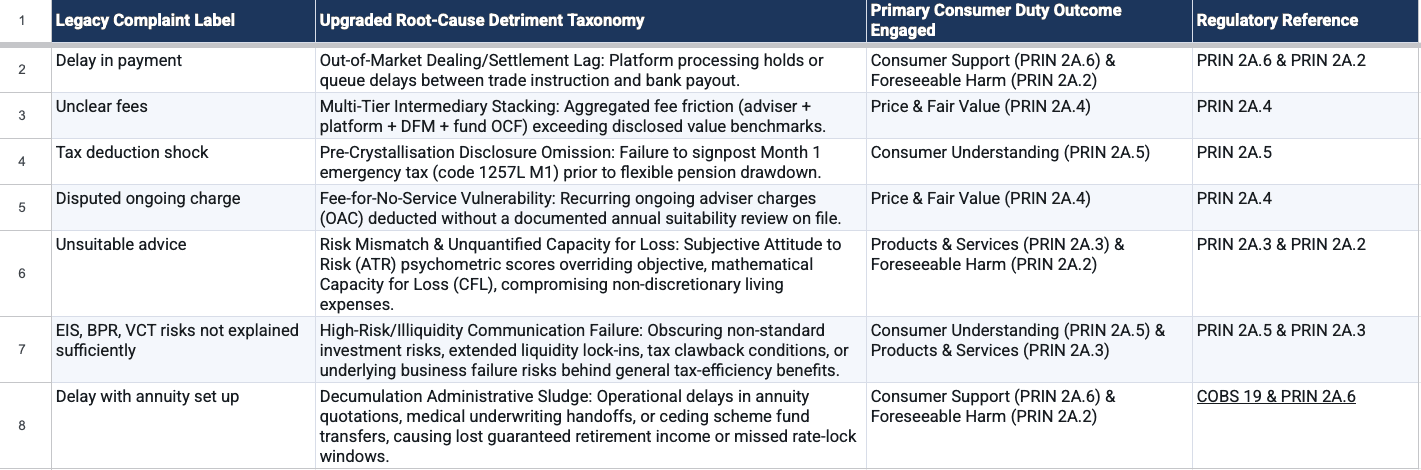
The Complainer: Turning Customer Grievances into an Active Consumer Duty Control Framework
10 November 2026 , 5 min
By building a robust control framework that links root-cause analysis, foreseeable harm assessments, and outcome testing directly into product oversight and board governance, firms do more than satisfy PRIN 2A—they insulate their balance sheets, protect senior management from personal regulatory liability, and build a genuinely resilient financial services business.
Read article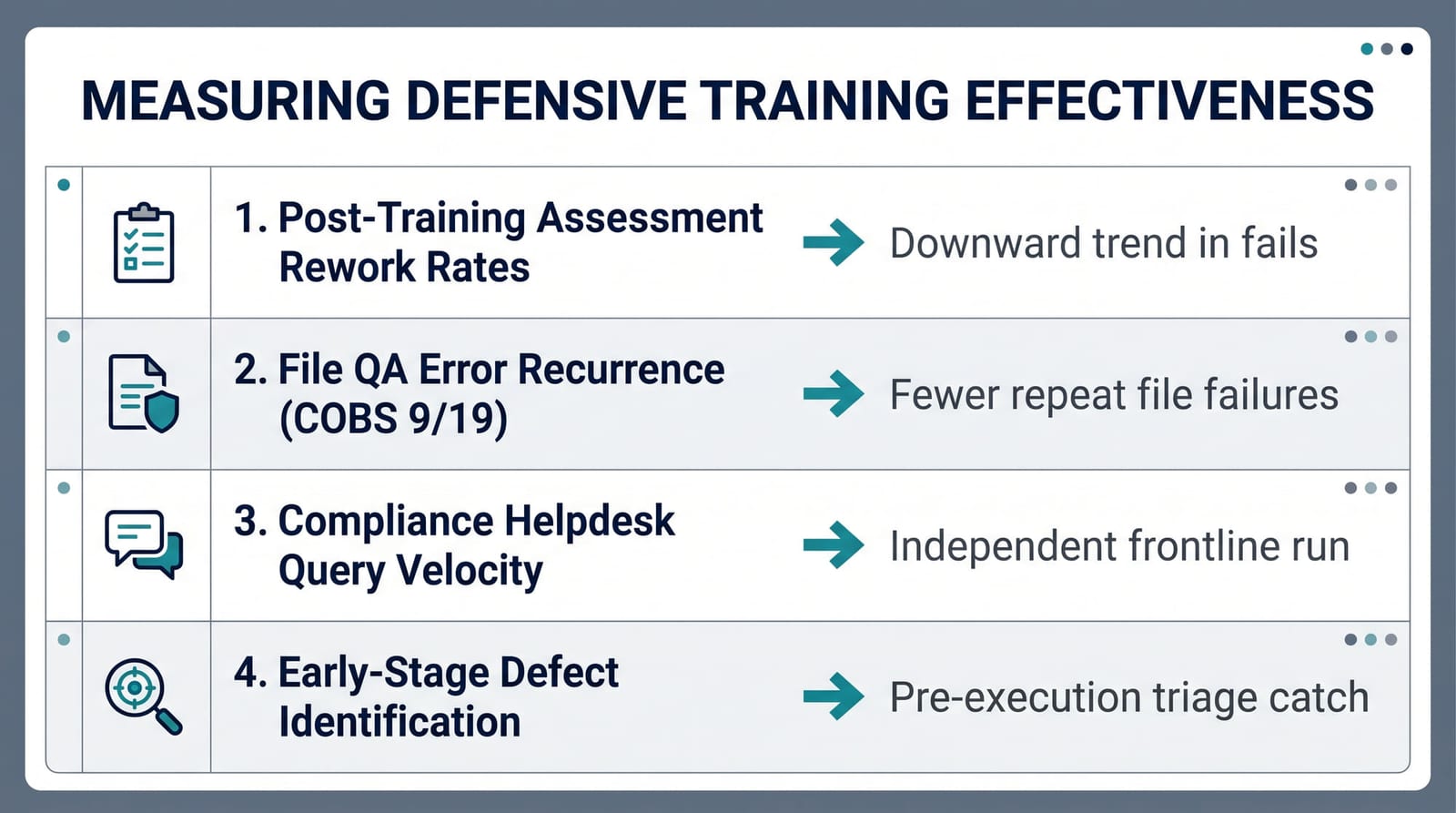
Beyond the Checkbox: Developing and Delivering Compliance Training That Actually Mitigates Risk
9 November 2026 , 5 min
Training is not a once-a-year disruption; it is the first line of defence in your operational governance framework. When aligned with your firm's second-line file reviews and SM&CR reporting, practical education protects your regulatory permissions and insulates senior management from personal liability.
Read article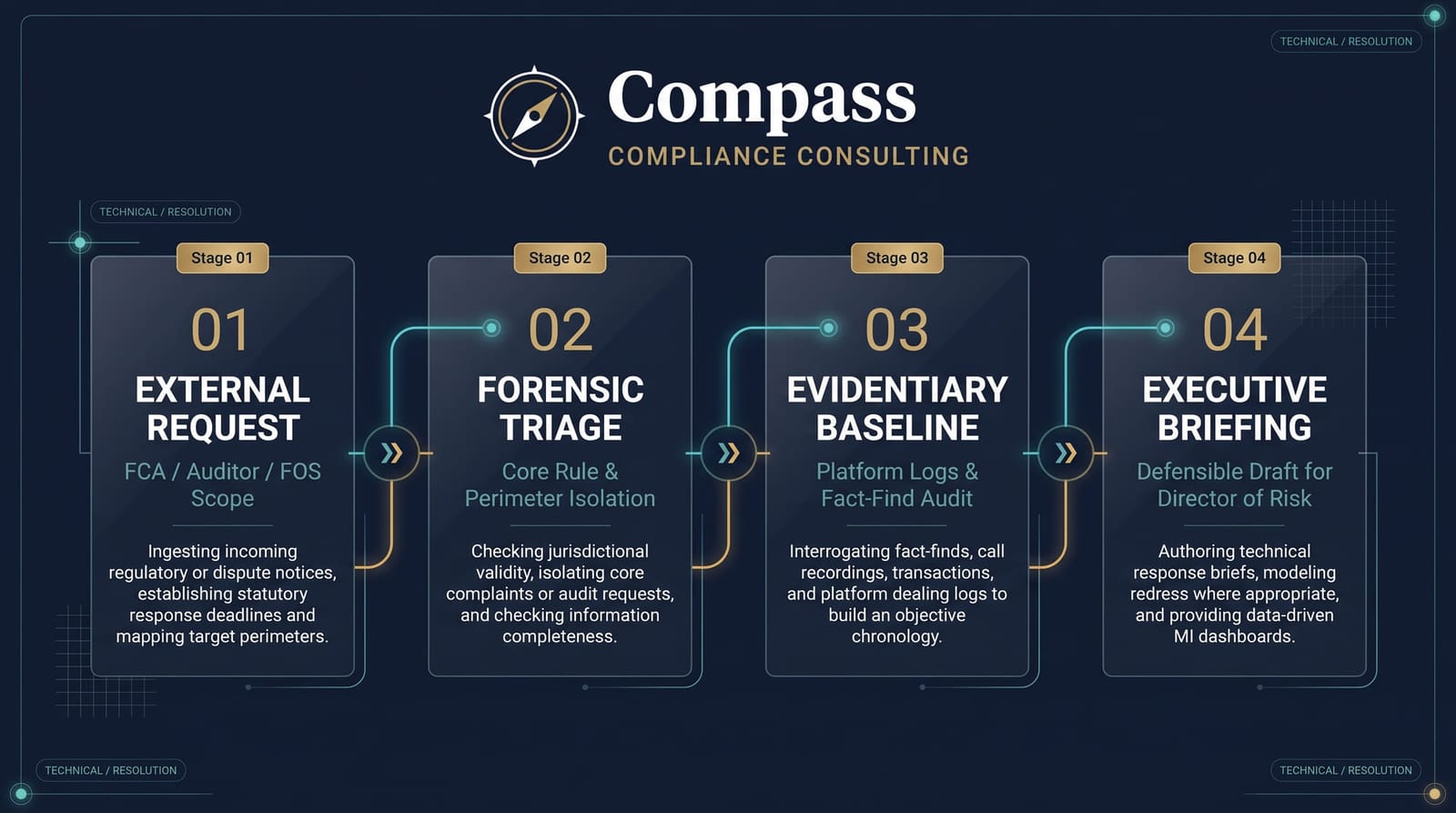
Bridging the Technical Gap for the Director of Group Risk
9 November 2026 , 5 min
By providing rigorous technical support to the Director of Group Risk, the compliance function ensures external stakeholders receive authoritative, evidence-backed submissions that protect the firm's authorisations and reputation. Simultaneously, it ensures operational teams receive practical clarity, maintaining compliant, defensible business practices across the entire organisation.
Read article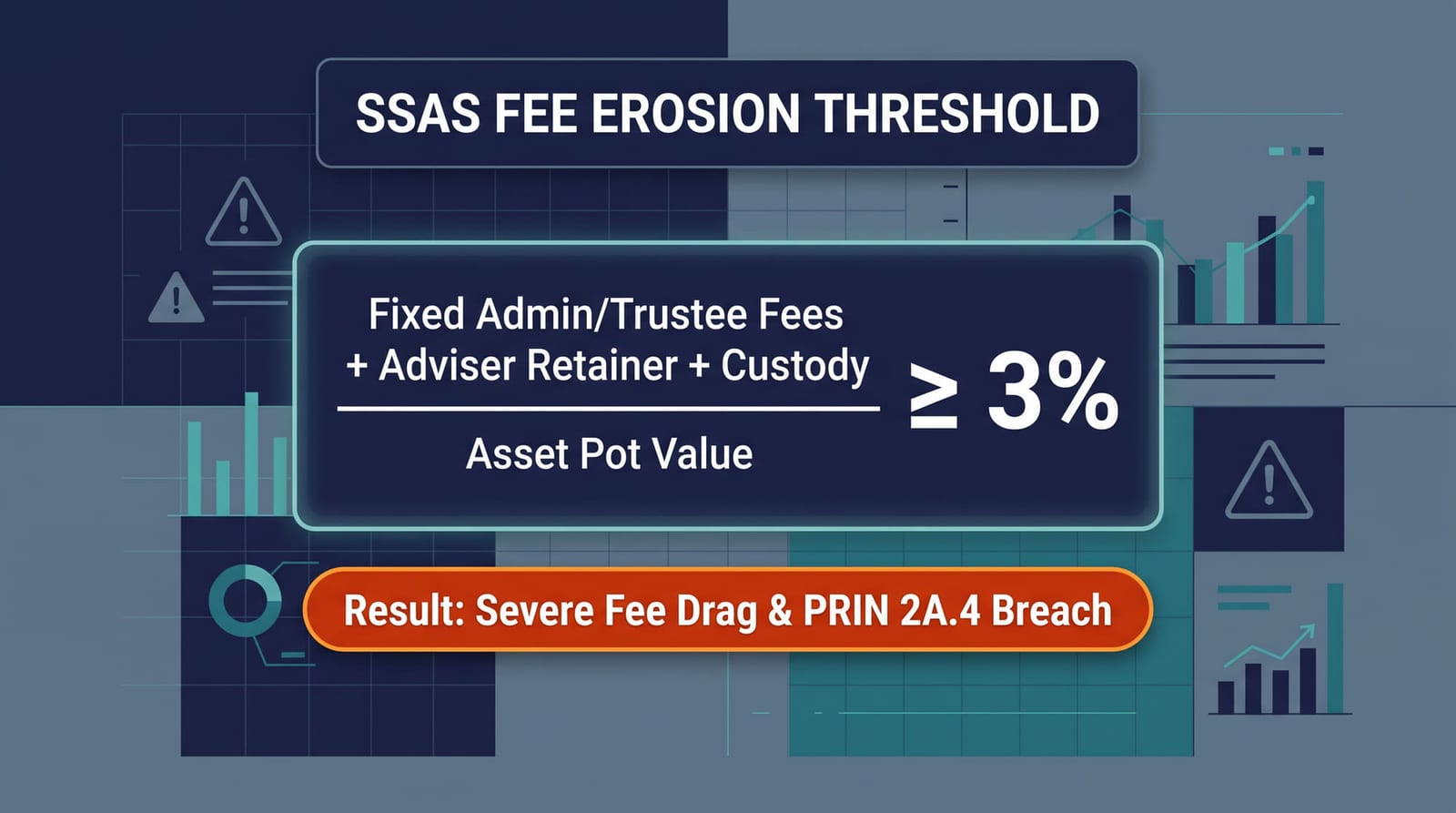
Consumer Duty and SSAS: 5 Critical Operational Impacts
8 November 2026 , 5 min
The distinction between an occupational trust and a personal pension wrapper does not exempt regulated firms from retail conduct expectations. Whether structuring the initial scheme, selecting underlying investments, or auditing ongoing fee extraction, firms servicing SSASs must embed data-driven outcome monitoring to prove their clients receive fair value and avoid foreseeable harm
Read article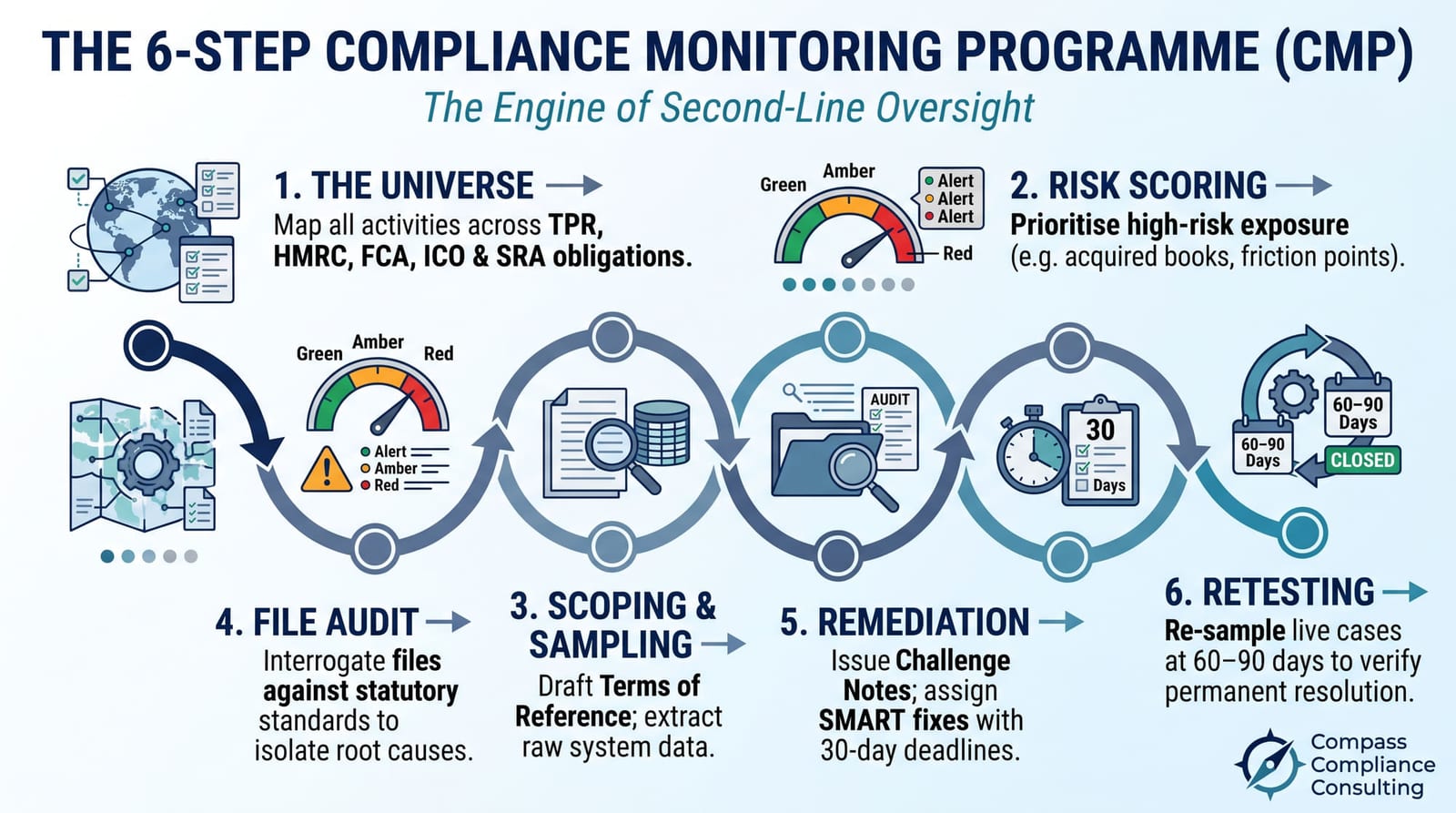
Demystifying the Compliance Monitoring Programme (CMP)
8 November 2026 , 5 min
An effective compliance framework does not treat regulatory obligations in isolation. The testing methodologies, root-cause diagnostics, and remediation loops that drive a successful Compliance Monitoring Programme apply directly across all high-stakes governance areas—including data protection, client privacy, and statutory information security.
Read article
Navigating UK GDPR and Data Protection in Practice
7 November 2026 , 5 min
Data protection is not an isolated legal duty; it is a foundational component of operational resilience and consumer trust. Embedding these disciplines ensures firms protect both their clients from harm and their business from regulatory enforcement.
Read article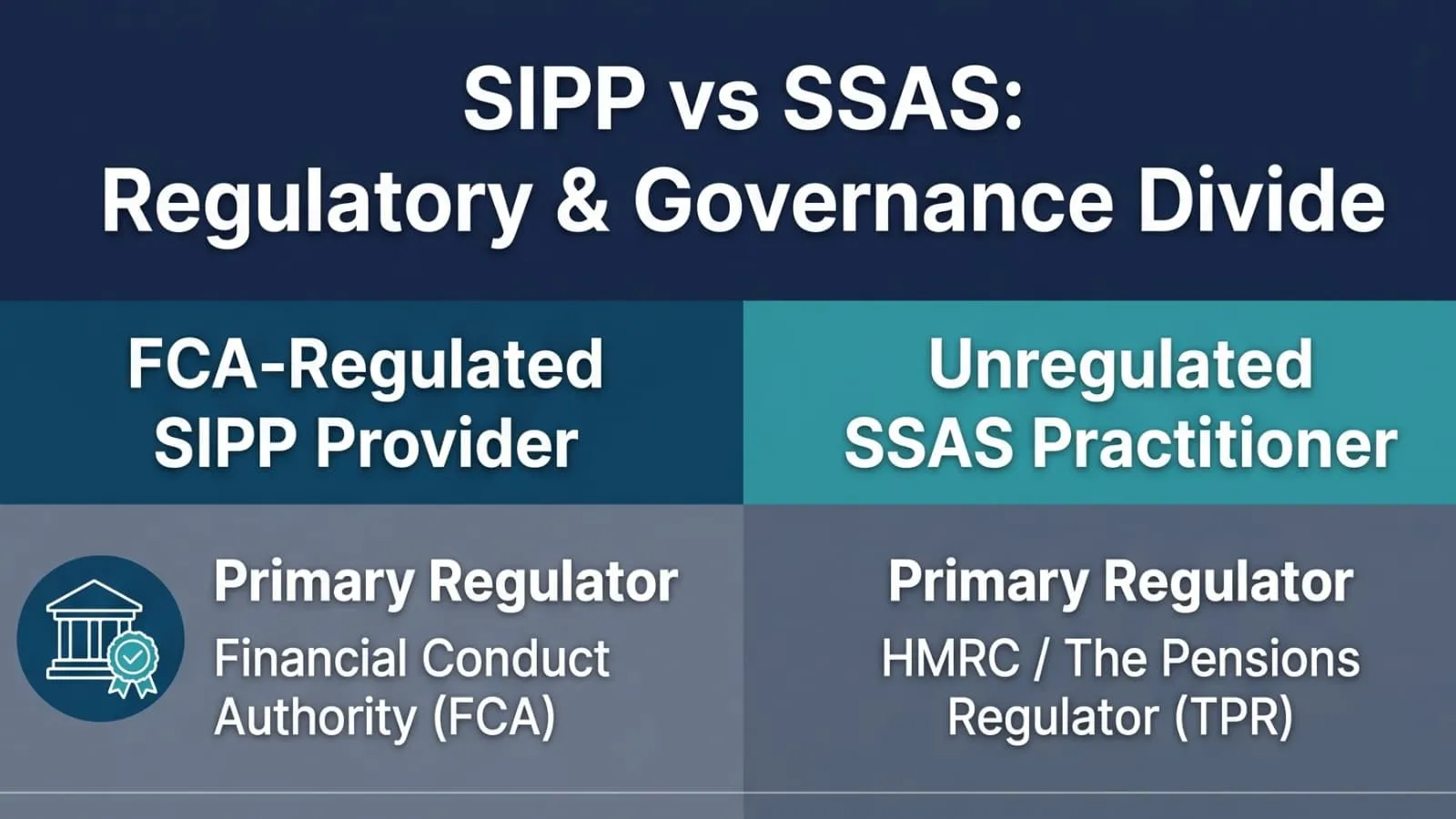
The Regulatory Blindspot: Why Unregulated SSAS Promoters Risk Massive Tax Bombs Under Consumer Duty Scrutiny
7 November 2026 , 5 min
Responsible SSAS providers already operate high-standard governance models, including structured annual trustee meetings to align member strategies with current rules. Bringing the entire SSAS sector under FCA regulation may create an even playing field
Read article
Consumer Duty Governance, Outcome MI and SM&CR Assurance
1 November 2026 , 11 min
Principle 12 asks for contemporaneous proof of customer outcomes. Activity statistics, dealing SLAs and a green dashboard do not provide it.
Read article
Decumulation Telemetry: Tracking SIPP Drawdown Lag as Foreseeable Harm
1 November 2026 , 9 min
A 48-hour dealing SLA can hide three or four weeks between a drawdown instruction and cleared money. That gap is a foreseeable-harm question under PRIN 2A.2.
Read article
The 31-Day MPAA Trap: Monitoring Statutory Trigger Disclosures in Flexi-Access Drawdown
1 November 2026 , 8 min
The Money Purchase Annual Allowance starts when taxable income is paid. The scheme administrator then has 31 days to tell the member. A document sitting in a portal is not that notice.
Read article
Fixed-Fee Erosion in Low-Value SIPP Pots: When Administration Fees Breach Fair Value
1 November 2026 , 8 min
A flat trustee fee that is trivial on a large SIPP can consume several % of a residual pot. PRIN 2A.4 looks at that cohort, not the average charge across the book.
Read article
The CETV Mirage: Why 2026 Multiples Look Nothing Like the 2021 Peak (And Why That Makes Advice Harder)
20 November 2026 , 5 min
UK DB pension CETV multiples have dropped from 30x–40x in 2021 to 18x–22x in 2026 due to higher gilt yields. Here is why lower transfer values actually raise the mathematical bar for suitability under COBS 19 and DBAAT file reviews.
Read article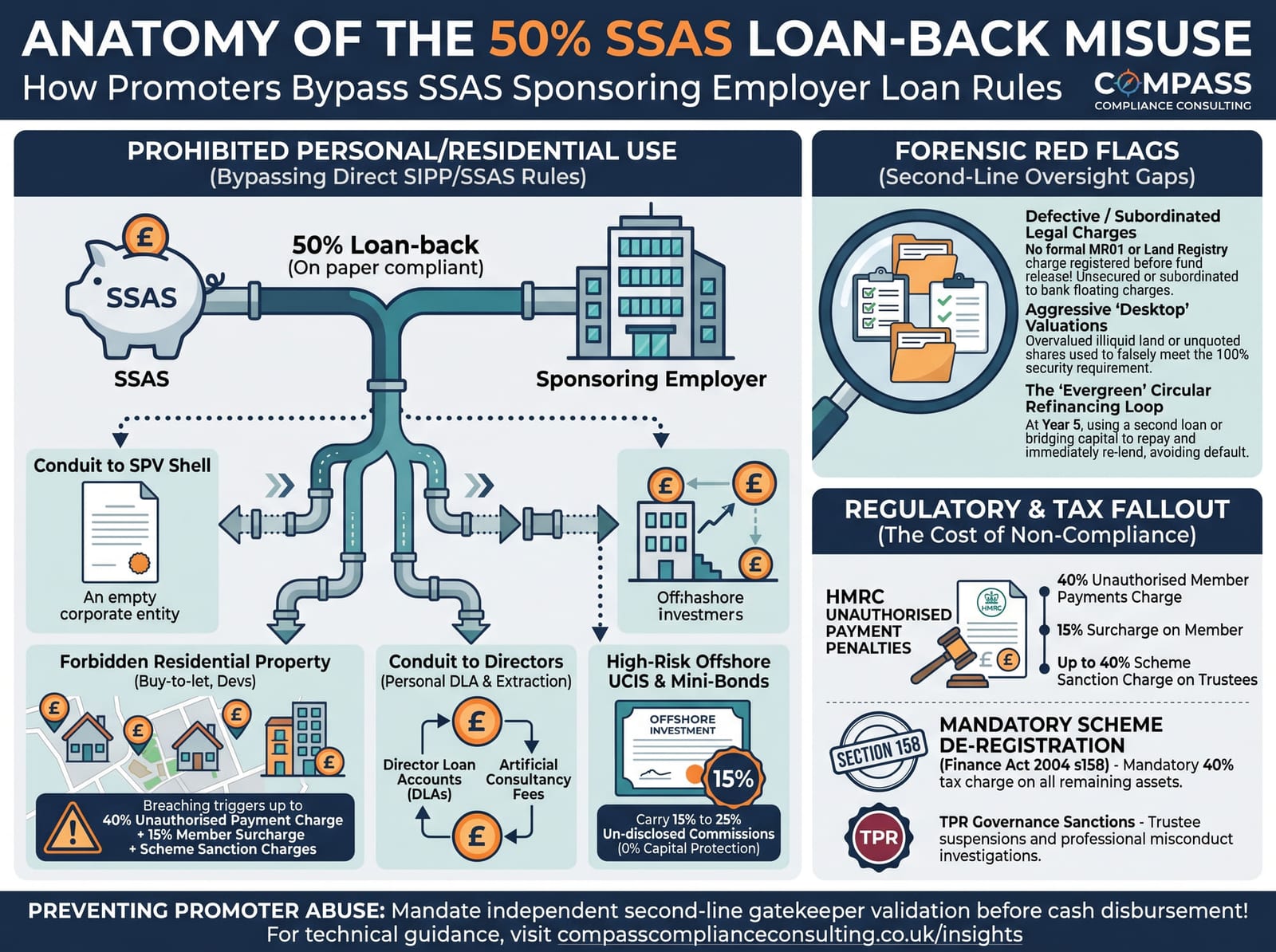
The Sponsoring Employer Conduit: Anatomy of the 50% SSAS Loan-Back Misuse
11 November 2026 , 5 min
The statutory loan rules under Schedule 30 of the Finance Act 2004 govern only the primary transaction between the SSAS trustees and the sponsoring employer. Promoters exploit this legal boundary by treating the borrowing employer as a pass-through conduit.
Read article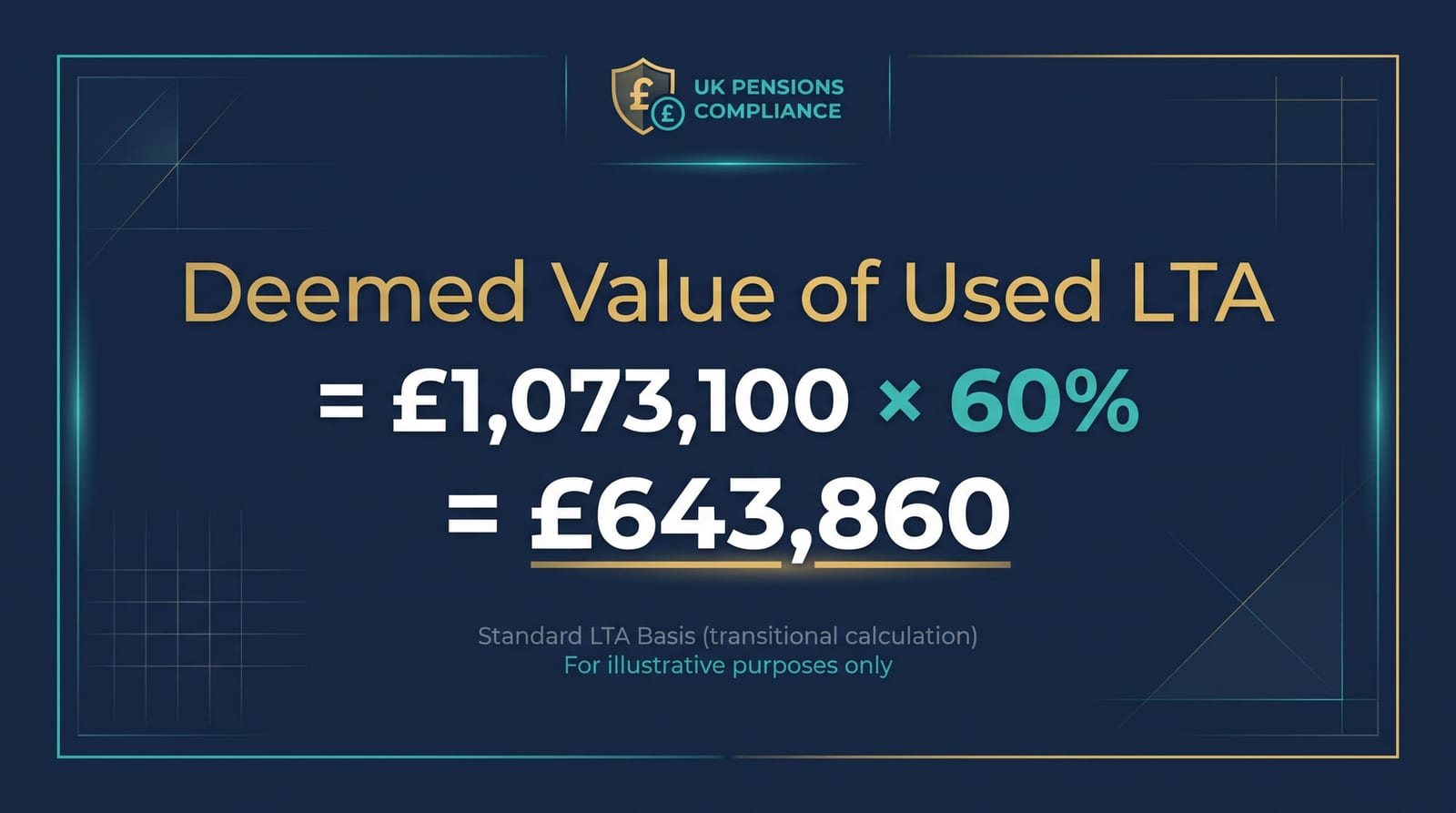
How to Research and Frame Genuine Technical Pensions Enquiries
9 November 2026 , 5 min
Technical support exists to resolve genuine legislative ambiguities, unusual cross-border issues, structural scheme rule defects, and high-risk regulatory conflicts. By researching first and applying the Fact–Research–Conflict format, operations and compliance ensure that when a technical question is raised, it genuinely warrants the escalation.
Read article
Strategic FOS Defence, Dispute Resolution and Forensic Redress Modelling
27 October 2026 , 11 min
A practical account of high-stakes complaints: eight-week final responses, DISP 2.8 time-bars, preliminary-view rebuttals and redress modelled to the FCA benchmarks.
Read article
The Jurisdictional Shield: Enforcing DISP 2.8 Time Limits Against Stale Claims
26 October 2026 , 4 min
A complaint about advice given eight or ten years ago is often a jurisdiction question before it is a suitability question. DISP 2.8.2R is the test.
Read article
Rebutting the Ombudsman Investigator's Preliminary View: The Mechanics of an Effective Escalation
26 October 2026 , 4 min
An adverse preliminary view is not the decision. It is a document that can be taken apart where it uses hindsight or misreads the product.
Read article
The 8-Week Final Response Letter: Drafting for the Ombudsman, Not Just the Client
26 October 2026 , 4 min
The eight-week letter is the brief the Ombudsman will read. An apology that concedes a breach is very hard to row back.
Read article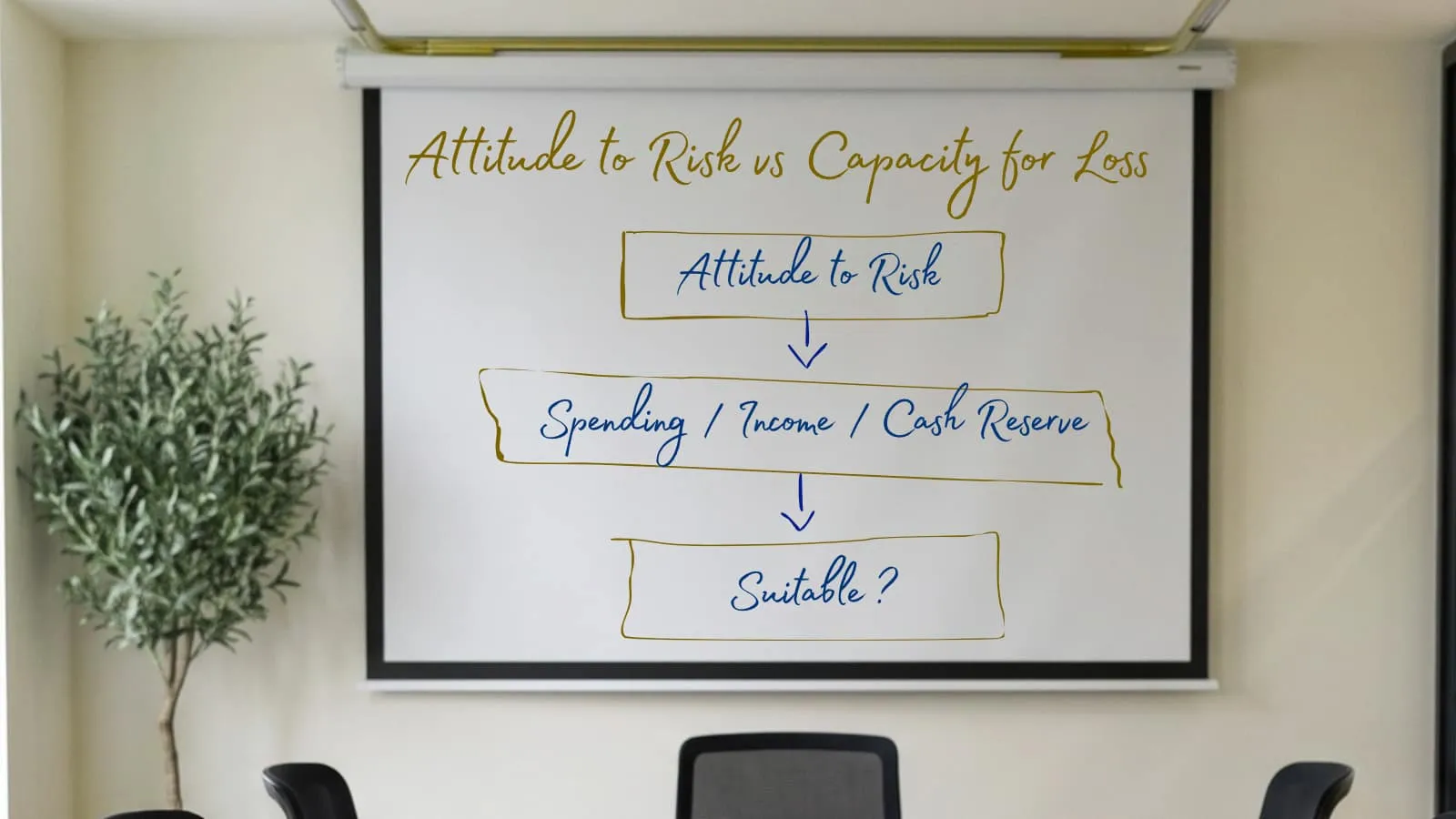
Attitude to Risk vs Capacity for Loss: Winning the Battle of Contemporaneous Evidence
26 October 2026 , 4 min
A signed risk questionnaire does not answer a complaint about losses. Capacity for loss, recorded at the time, does.
Read article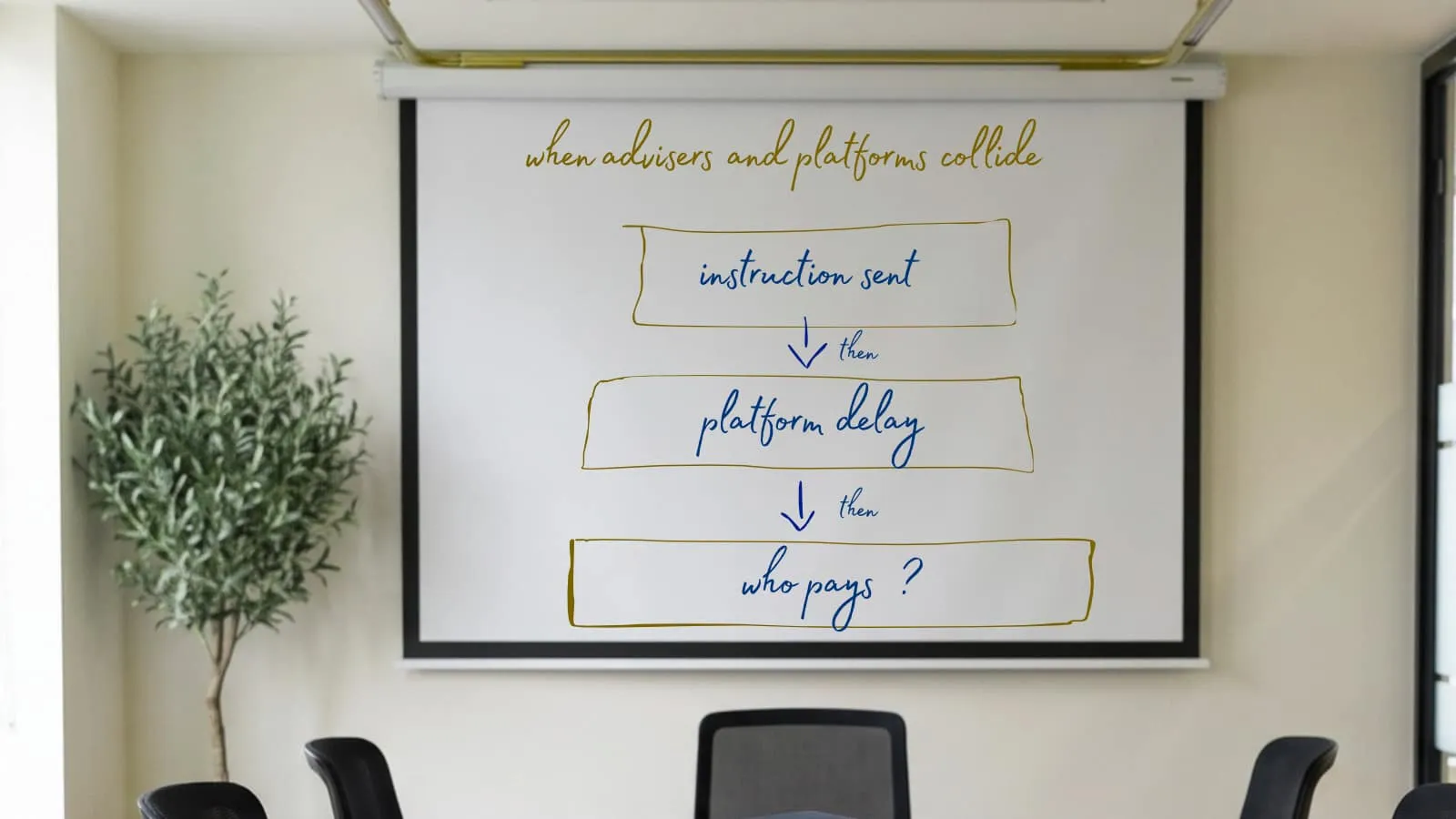
When Advisers and Platforms Collide: Defending the Boundaries of Intermediary Responsibility
26 October 2026 , 4 min
A dealing backlog at the platform is not, by itself, an advice failure. The timeline shows who had the instruction, and when.
Read article
Halting Regulatory Retrospectivity: Defending Legacy Advice Against Post-Consumer Duty Claims
26 October 2026 , 4 min
Consumer Duty language in a complaint about pre-2023 advice does not rewrite the rules that applied on the day. DISP 3.6.4R keeps the case in its own time.
Read article
SIPP Custody vs Advisory Due Diligence: Applying Adams v Options UK to Intermediary Disputes
26 October 2026 , 5 min
When a SIPP asset fails, the operator's duty and the adviser's duty are not the same duty. Adams v Options UK does not merge them.
Read article
Turning FOS Casework into Consumer Duty Root-Cause MI: Complaints as Governance Telemetry
26 October 2026 , 4 min
A falling complaint count is not root-cause information. DISP 1.3 and the Consumer Duty board report ask what kept going wrong.
Read article
Beyond Simple Cash Differences: Why Generalist Accounting Fails FCA Redress Benchmarks (FG17/9)
26 October 2026 , 4 min
Money in minus money out is not a pension redress calculation. FG17/9 and DISP App 1 require the position the client would have been in.
Read article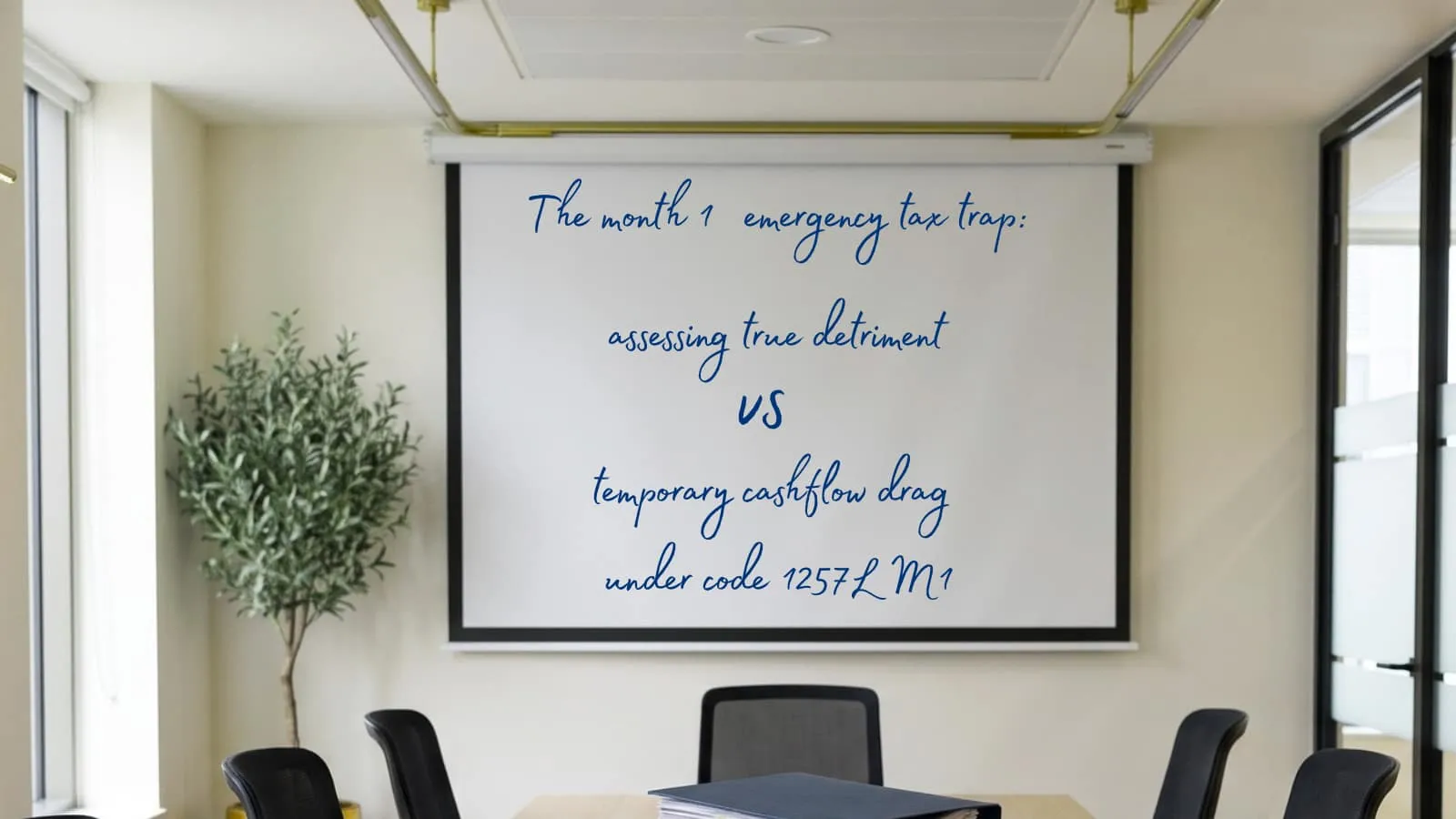
The Month 1 Emergency Tax Trap: Assessing True Detriment vs Temporary Cashflow Drag Under Code 1257L M1
26 October 2026 , 4 min
A Month 1 tax code can withhold thousands on a first drawdown payment. Most of that money is reclaimable. It is not automatically redress.
Read article
Benchmarking Distress and Inconvenience: Defending Against Exaggerated Non-Financial Detriment Claims
26 October 2026 , 4 min
A demand for £5,000 to £10,000 of upset, attached to an ordinary delay, sits outside the Ombudsman's published bands. The log is what places the case.
Read article
Forensic File Reviews, Complex Pension Scrutiny and Ongoing Servicing Audits
22 October 2026 , 12 min
A forensic file review tests defined benefit transfers, high-risk SIPPs and ongoing charges against COBS, SYSC and the Consumer Duty, before a regulator or ombudsman does.
Read article
Financial Crime & Unauthorised Intermediary Funnels: Spotting the "Introducer" Red Flags
20 October 2026 , 6 min
The unregulated introducer model has driven SIPP provider failures and FSCS levies for two decades. Toxic funnels leave repeatable footprints that a structured red-flag audit can find.
Read article
Decumulation Friction: Phased Drawdown, In-Specie Transfers, and Illiquid Asset Traps — When It's Not So Straightforward
18 October 2026 , 6 min
In bespoke SIPPs holding property, unquoted equities or loan notes, pension flexibility is often theoretical. Crystallising benefits without a clear cash pathway creates operational drag, Consumer Duty breaches and complaints.
Read article
SIPP Borrowing & Commercial Property: Navigating the 50% Net Asset Cap and Connected-Party Leases
16 October 2026 , 5 min
Commercial property in a SIPP or SSAS sits under intense HMRC scrutiny. Breaching the 50% borrowing cap or tolerating connected-party rent arrears triggers punitive unauthorised payment charges.
Read article
Auditing Illiquidity and Valuation: The 30-Day Standard Asset Test Under SIPP Capital Adequacy Rules
14 October 2026 , 5 min
Labelling illiquid investments as standard assets suppresses a SIPP operator's capital requirement on paper. A forensic liquidity audit tests every asset against the 30-day gate.
Read article
SIPP Operator Due Diligence: Lessons from Adams v Options UK and the FCA Due Diligence Framework
12 October 2026 , 6 min
An execution-only disclaimer no longer shields a SIPP operator. After Adams v Options UK, reviewers ask whether the operator actively vetted the asset and the distribution channel before accepting it.
Read article
Abridged Advice vs Full Advice: Managing the Boundary Under COBS 19.1A
10 October 2026 , 5 min
Abridged advice can only ever produce two outcomes. Firms that blur the boundary into full advice risk breaching the contingent charging ban and issuing invalid Section 48 confirmations.
Read article
The DBAAT File Audit: Scoring Section 166 Redress Liabilities Before the Regulator Arrives
8 October 2026 , 5 min
The FCA reviews defined benefit transfer books with the DBAAT, not narrative impressions. A single gate failure on capacity for loss or information gathering can render the whole advice outcome unsuitable.
Read article
Unpacking Scheme Solvency: Handling Employer Covenants and PPF Nuance Under COBS 19.1.2DG
6 October 2026 , 4 min
Employer covenant weakness is often used to justify an otherwise unsuitable defined benefit transfer. COBS 19.1.2DG sets clear limits on how scheme solvency and PPF compensation are presented.
Read article
Stress-Testing the APTA & TVC: When Stochastic Cashflow Models Cross into "Wishful Thinking"
2 October 2026 , 5 min
Cashflow modelling is one of the most heavily scrutinised parts of a defined benefit transfer file. Optimistic stochastic models are often used to paper over structural cracks in transfer sustainability.
Read article